Community Support Funding (City of Steamboat Springs)

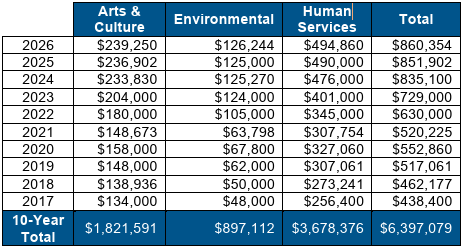
The City of Steamboat Springs Community Support Funding has provided nearly $5.5 million over the past decade to qualifying organizations across the Yampa Valley. City Council allocates several hundred thousand dollars each year to assist community organizations that fall within one of the following coalitions: Arts & Culture, Environmental, and Human Resource. Applications are ranked on a set of criteria by a selection committee with expertise in the coalition focus.
Community Support requests must relate to the following criteria:
- Activity/program reduces city service requirements and/or aligns with City Council’s Mission, Vision and Values.
- The grant is not more than 30% of the organization’s total budget.
- Organization indicates there is strength/diversity among their other funding sources.
The Yampa Valley Community Foundation serves on the steering committee for these annual grants.
In 2026 the City of Steamboat Springs directed $860,354 to support 44 different agencies and organizations serving the community. Awards varied from $2,254 to $87,343.
To apply or contact your coalition chair, please see below:
Annual Timeline
(Dates subject to change)
- September 1 – Applications open
- October 15 – Applications close
- During month of November – Applicant interviews
- Late December or early January – funding recommendation presented to City Council
- January – grant awards announced and first round of distributions issued
- July – second round of distributions issued (for grants over $10,000)
Human Resource (Health & Human Services Organizations)
For questions about the HR Coalition or the application, visit the HRC webpage here, or contact coalition chair Jen Bruen: 
Note this coalition’s grants are funded by both city and county funds.
Arts & Culture (incl. Humanities)
For questions about the Arts & Culture Coalition, please contact coalition chair Kim Keith: 
For questions about the grant application, please contact Greg Hamilton: 
Applicants must complete the application online at the gold button above. If you would like to download all questions to prepare your answers offline, download them here:
Environmental
For questions about the Environmental Coalition, please contact coalition chair Todd Hagenbuch: 
For questions about the grant application, please contact Greg Hamilton:
Applicants must complete the application online at the gold button above. If you would like to download all questions to prepare your answers offline, download them here:
Important Information and Resources for Applicants
All grantees who received Community Support funding in 2025 will be required to submit a report on the City’s official form. This report may be required upon applying for the next year’s grants or, if not applying again, by December 15th, 2025. Signed, completed reports may be emailed to the chair of your coalition listed above.
Frequently Asked Questions
Following are commonly asked questions about the score card criteria. If you have additional questions, please contact your coalition chair listed above.
Is my organization eligible to apply?
1) Must be in one of the three eligible sectors for these Community Support funds: Arts and Culture, Environment, and Human Resources (a.k.a. health and human services). If an organization addresses multiple service areas, for the purpose of determining eligibility, the coalition chairs determine an organization’s primary focus area with final approval by the City. If not in one of the coalitions, see the Granting Procedures document linked below for other ways to request funding from the City.
2) Must be a 501(c)(3) nonprofit or eligible public charity. If unsure about the eligibility of your category of organization, contact a coalition chair before applying.
How much should we ask for?
What are the arguments for requesting either Operational Funds or a Program grant?
What does it mean to reduce the City's "service requirement" or align with the City's mission/vision/values?
How do we demonstrate a "positive impact " of our work for this grant application?
What are examples of "meaningful collaboration with other service organizations"?
How do you determine if our operation is stable (staff and leaders)?
Grant reviewers may consider turnover rates for key staff and board members; thoughtful policies for succession planning and term limits; each individual’s connection to the organization’s mission; a diversity of lived experience to provide a variety of perspectives; and appropriate numbers of people for the work at hand. The actual mix of people and policies will vary, but the committee’s overall impression should be one of stability and resilience.
What constitutes "strength/diversity" in our other funding sources?
Heavy reliance on a single funding source— whether a donor, a specific grant, an annual fundraiser, or service fees— raises questions about revenue stability when circumstances change. Each organization will have a different array of funding sources, so the committee will assess whether there is a history of consistent funding and an array of sources that provide diversified stability if one or more key funding sources were to change.
How do you determine if our financial health is good?
In addition to diversified funding sources (see above) two key concepts for nonprofit financial health are solvency and transparency:
- Solvency means cash reserves and/or liquid assets are appropriate relative to the budget. There should be no material concerns about the organization’s ability to meet its financial obligations. Best practices for nonprofit organizations recommend 3-9 months cash-on-hand, but understandably there may be reasons an organization has less or more than that amount, depending on timing or the unique circumstances. If your cash-on-hand is significantly higher or lower, please explain why in your application.
- Transparency can be demonstrated with clear, concise, internally consistent financial statements that are easy to interpret. Revenue, expenses, and assumptions should be clearly explained and, for programmatic grants, appropriate to the request.
What should we include within "in-kind support from City and County"?
What should be included in our financials for Question #12 (#15 for HRC)?
• If your organization has received an audit within the past fiscal year, providing audited financials is always preferred.
• Your statement of financial position (balance sheet) includes both assets and liabilities as of a recent reporting date. If your organization has no assets or liabilities, this must be stated in the position document.
• Your statement of activity (profit and loss) includes, for the most recent full fiscal year, both your sources of revenue and your expense line items.
What should be included in our current budget for Question 13 (#15 for HRC)?
For Question #13 (not applicable for HRC), you will enter the numerical figure for the total expenses shown in the budget document you upload to Question #13a.
• Your uploaded budget must include both revenues and expenses for an entire fiscal year. A month-by-month cashflow report is not needed.
• It is recommended to provide a consolidated budget with categories for revenues and expenses such as “state grants,” “foundation grants,” “donations,” etc. Too many individual line items can be unhelpful to reviewers unless there are important details such as whether a specific funding source is secured or projected. Another example: if you receive multiple different state grants, listing them individually would indicate more funding diversity than a single “state grants” line item.
• Best practice is a balanced budget, meaning any discrepancy between total revenues and total expenses is clearly explained. For instance, a deficit might be funded by transferring funds from reserves. Or a surplus might be rolled forward to next year.